

Compass Series
Because every map needs a compass. In this series, we will deep dive with the minds behind EcoMap to break down how we do what we do and how it helps you grow and thrive.
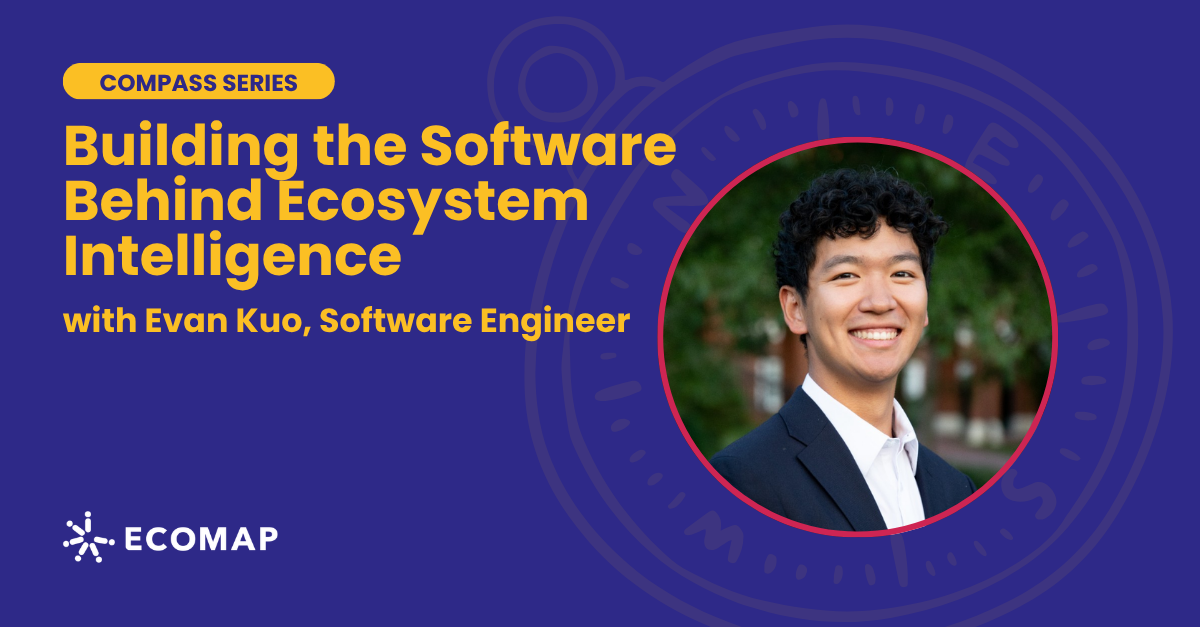
Evan Kuo is a Software Engineer at EcoMap, where he works across the full stack to build the tools that ecosystem leaders and entrepreneurs interact with every day. Recognized by Technical.ly as a 2024 RealList Engineer, Evan first joined EcoMap as a data engineering intern in 2023, where he contributed to key improvements in the team's data automation systems. He then spent nearly two years at A-Level Capital, a Johns Hopkins-affiliated venture capital firm, rising to Head of Platform and Partner before returning to EcoMap full-time in 2024. A Johns Hopkins graduate, his experience spans product management, software engineering, data analytics, and venture capital.
In this conversation, he talks about what brought him back to EcoMap, how his range of experience shapes the way he builds, and what it takes to engineer the tools that help communities coordinate support and connect entrepreneurs to resources.
You interned at EcoMap in 2023, spent time in venture capital, and then came back as a full-time software engineer. What brought you back, and what changed in how you saw the company or the work?
Being in venture capital allowed me to talk to so many founders and gain an insider perspective across a broad range of tech industries. It was a great experience, but I kept wanting to get my hands dirty and be more involved in the difficult, day-to-day things that actually make a startup succeed.
When I was an intern, what stood out to me most was the people. The team was talented, passionate, and supportive. I also believed in what we were trying to do, which was to make information accessible to anyone and connect people who were doing important work.
When I decided I wanted to join a startup again, EcoMap was the first company I reached out to. Everything I remembered about the team was still true, but now there was an even stronger sense of focus and unity. The team was also just starting to build out the new platform and migrating to a more modern tech stack. I was excited about the opportunity to get on the ground floor of building our next-generation product.
You've worked in data analytics, data engineering, product management, venture capital, and now software engineering. How does that range of experience influence the way you approach building at EcoMap?
One of the most fulfilling parts of working at EcoMap is the responsibility and autonomy I have. We move very quickly and dynamically, which means I have to keep my head up and consider how my work affects the customer, other developers, and the company.
I can be pulled onto different projects and parts of the product, and I have enough of a diverse background to jump in and provide value wherever necessary. It allows me to approach my work from different perspectives, which makes me a better teammate and helps us be much more precise with how we build our product for our customers.
Our customers and the people they help come from very different backgrounds, too. That range of experience allows me to put myself in their shoes as I'm building and consider how they actually want to use our products.
EcoMap's customers range from lean local ESOs to statewide agencies. How do you think about building features that work well across that spectrum?
I put a lot of trust into our product and customer-facing teams, who spend significant time talking to our customers and understanding their needs. By the time something reaches me to build, I know that a lot of planning and thought have gone into how those needs have been addressed across all our customers.
When I'm building, I focus heavily on UX and human interaction with our product. As I build features and test them, I pay close attention to how every user flow feels. Does it feel snappy? Intuitive? Is it enjoyable to use? I want everything I build to be a seamless experience for our customers, regardless of the scale at which they're helping people with our products.
AI is a major part of how EcoMap delivers ecosystem intelligence. From the engineering side, how does your team approach integrating AI into the products customers use, and what does that look like in practice?
We're not adding AI for the sake of it. We're very deliberate about bringing it into our products in a way that makes a real difference in our customers' workflows. We want to surface new insights about their ecosystems that are hidden behind piles of data and spread across the different tools we offer.
We're also deliberate about ensuring the accuracy of the AI models we use, building in guardrails and testing thoroughly to make sure the integrations we deliver are reliable and useful. Engineering at EcoMap sits alongside data, product, and customer success teams. How does that collaboration work day-to-day, and how does it shape what gets built?
If I had to put it into one word, transparency.
We've got a small team. One of our superpowers is the trust and honesty we have with each other, which allows us to challenge one another, talk directly, and pivot quickly when necessary.
We have good systems in place to keep things running smoothly, but we're still flexible when we need to be. There's a strong sense of ownership here, so everyone knows exactly who to ask to get something done or a question answered. And the level of closeness that the teams operate with helps avoid information silos, keeping the shared context we need flowing freely. That leads to a product with a strong, unified direction and vision. EcoMap has grown its product suite significantly over the past few years, from ecosystem mapping to ERM, Discover, and the Nonprofit Intelligence Dashboard. What does that pace of product development require from the engineering team, and how do you keep things reliable while moving fast?
We stay very focused on the goal when building, and we're constantly asking ourselves which problems are most important to solve. We bring up potential questions and issues as early as possible, and we aren't afraid to change our approach when we recognize a better way forward.
We put a big focus on testing, both automated and manual. That ensures we can maintain stable functionality as we build new features and improve existing ones.
We also take time to make sure we build things the right way. We don't rush to solutions, and we make sure the code we write is well-documented and technically sound. It may require a little more thought up front, but it's a worthwhile investment in maintainability and flexibility for the future. What's a technical challenge you've worked on at EcoMap that you're proud of, and what made it meaningful?
One of the biggest technical challenges we've tackled, and the one I'm most proud of, is working with the massive corpus of data that sits at the center of our products. It's an ever-changing entity, with data assets collected years ago sitting next to new resources we scraped today.
As we think through new ways to use and present this data in the most helpful way for our customers, we need to keep everything compatible with our current offerings while modeling things in a way that's future-facing and valuable.
Technically, that means learning to work with messy data that doesn't always look like what we expect. We work within the constraints of making sure our legacy products can still read this data while making gradual improvements to the shape of it, making it more efficient, robust, and useful for the customers on our new generation of products.
When you look at where EcoMap's products are headed, what excites you most about what the engineering team is building next?
I'm excited about the ways we've continually improved how we collect and update data for our customers. We're using cutting-edge web scraping tools, leveraging AI and other methods to collect and refine our data corpus. It's an interesting technical problem to solve, and it's rewarding to know that every resource we collect will eventually reach our customers and the people they're working to help.
The nature of how information is found and understood on the internet is changing, and it's been fun to adapt to those changes and help define what it means for someone to find the resources they need.
You work in the office at EcoMap. What's the culture like, and how does the team stay connected when you're spread across different places?
I work in the office most days. Everyone is focused and passionate about the company's vision and direction. But beyond that, we care about each other. We're a tight-knit team, and we care about each other as people, not just as coworkers. That closeness leads to mutual trust and respect, which also allows us to communicate honestly. We're not afraid to disagree with each other to do things the right way.
The environment is fun. Even though we're focused and working hard, we still enjoy ourselves while doing it. We'll sometimes have all-hands where the whole team gathers in Baltimore, and those have been great for connecting with our remote teammates. We also have virtual events like PowerPoint nights or playing games like Wavelength.