


This article answers:
What's changed for state economic development leaders in 2026?
How should states differentiate when chasing the same strategic sectors?
What kind of data infrastructure do economic development leaders actually need?
TL;DR: Federal policy shifts, tariff uncertainty, and deals at unprecedented scale are reshaping state economic development. In EcoMap's latest Ecosystem Talks, Sherrod Davis sat down with Tim Sullivan, who led the New Jersey Economic Development Authority for eight years, for a candid conversation about what separates states that win from states that don't, why money is a tiebreaker rather than a strategy, and what data infrastructure economic development leaders really need.
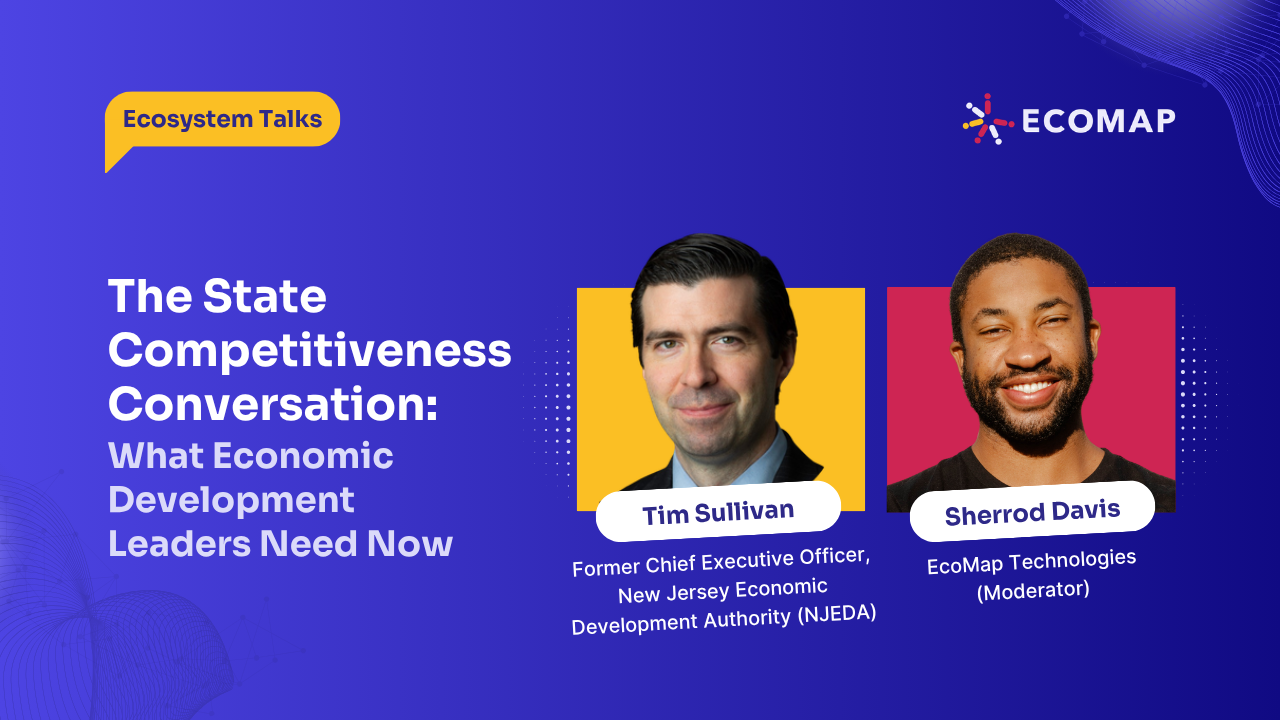
The job of running a state economic development authority looks different than it did even three years ago. Deal sizes have moved from the hundreds of millions to the tens of billions. The federal government is back in the deal-making business after a multi-year hiatus. And nearly every state is chasing the same handful of strategic sectors.
In this Ecosystem Talks webinar, Sherrod Davis, co-founder and CEO of EcoMap Technologies, sat down with Tim Sullivan, who led the New Jersey Economic Development Authority from 2018 through the end of 2025 under Governor Phil Murphy. Sullivan previously served at the Connecticut Department of Economic and Community Development and in Mayor Michael Bloomberg's Economic Development Office in New York City. The conversation focused on what state economic development leaders across the country are sitting with right now.
What Has Actually Changed for State Economic Development Leaders?
Sullivan opened with what he sees from six months outside the seat. The pace of acceleration has gotten faster, and the scale of deals has gotten dramatically larger.
"In the old days, a couple hundred million dollar transaction was a big deal," Sullivan said. "Now you're seeing transactions in the tens of billions. To use the Jaws cliche, you're gonna need a bigger boat. It's a different sized animal than our systems historically have even been able to imagine."
The federal government's return to active deal making, accelerated in the last 18 months after the CHIPS Act laid the groundwork, has added a new variable. State economic development leaders now operate in an environment where federal priorities and federal money shape the playing field for major investments in semis, advanced manufacturing, and life sciences.
Sullivan said his time at NJEDA covered the two largest macro shocks of the era. The pandemic, and two federal administration transitions that produced significant policy swings.
"Particularly in the pandemic, and I think this gets to why EcoMap exists, the data and visibility that people have into what's even really going on in their own ecosystems is, on a good day, hazy," Sullivan said. "When you're in a real crisis, keeping a decent tab on what was happening in your neighborhood, your county, your state was really hard."
The challenge in those moments is keeping short-term reaction and long-term trajectory in view at the same time. The fundamentals of any state economy do not shift on a dime, even when the news cycle suggests otherwise.
What Does the Governor's Office Actually Need from Economic Development Leaders?
Sullivan emphasized that economic development leaders need to bring both quantitative and qualitative intelligence to the governor's office. Spreadsheets matter. So does the texture of what is actually happening inside a company's C-suite or on a commercial corridor.
"The worst thing you can do when you're giving someone advice is just repeat the last thing somebody told you," Sullivan said. "You need to have 10 or 20 good qualitative conversations in your head and be having those constantly."
That means building a team that keeps its fingers on the pulse across multiple parts of the economy at once. The CEO of an economic development organization cannot be the only person sourcing intelligence. Sullivan described having staff who could speak credibly with pharma C-suites, startup founders, and commercial corridor business owners alike.
Every State Is Chasing the Same Sectors. How Should States Differentiate?
Sullivan agreed with the premise. Data centers, semiconductors, clean energy, and advanced manufacturing are on every state's priority list. The question is what to do about it.
His first answer is discipline about what not to chase. New Jersey does not have thousands of acres of undeveloped land. A 5,000-acre greenfield project near a Sun Belt airport is not New Jersey's dance, and chasing it aggressively wastes state resources.
"That's really hard to tell a governor, to tell a mayor, to tell a county executive, to tell a chamber of commerce head," Sullivan said. "I know there's lots of headlines and I know this feels like a big sexy thing to go chase. It's kind of not our dance. We don't really know how to do that one."
His second answer is to lead with workforce capability, higher education pipelines, infrastructure, and quality of place rather than money. Money is a tiebreaker in a competitive situation, not the basis of a pitch.
"If you're pitching an advanced manufacturing project and you don't have the right kind of sub-focus that company is looking for, you could build the project yourself and give it to them for free and it doesn't make any sense for them to do it," Sullivan said.
For corporate headquarters projects in particular, executives want to know whether their kids will have good schools and whether the surrounding towns are places people actually want to live. Those factors carry real weight in CEO-level relocation decisions.
What Data Capabilities Make State Economic Development Work?
When Sullivan took over NJEDA, the organization did not have the analytical capacity he believed it needed. NJEDA had been around for decades without a dedicated economics function. Sullivan added a small economics team that could work with implant data, REMI models, and BLS data in ways that informed real strategic decisions.
The granularity matters because top-line numbers rarely tell the story state leaders need.
"The top line unemployment rate is a really silly indicator of how to care about your economy," Sullivan said. "You can explain it to your grandparents. How can you add jobs and the unemployment rate goes up, and you shouldn't be mad about that, you should be happy you added jobs?"
Below the headline numbers sit the subsector trends, the entrepreneurial ecosystem data, the venture capital flows, and the leading indicators that tell a state leader what is actually happening on the ground. Sullivan referenced the back-of-the-envelope dashboard NJEDA built during the pandemic, which tracked NJ Transit ridership data as a signal of how return-to-office was actually playing out. Bus ridership recovered faster than train ridership, which told the team something specific about which types of jobs were coming back.
Sullivan was among the first to review EcoMap's Economic Intelligence Monitor, which gives state leaders a customizable view of how their state is performing against peer states they choose.
"People who sit in the CEO seats of economic development authorities are really competitive," Sullivan said. "We want to know how we're doing compared to our peers. Peers may not be your immediate neighbors. Peers are who you think of as competitors."
The value for Sullivan is being able to look below top-line indicators at the granular data that moves month to month and quarter to quarter, customized to the comparison set that matters to your state.
Why Does Narrative Matter as Much as Data?
A point came up repeatedly across the conversation. Data does not move decision makers on its own. The job is to pair the data with a narrative that frames what is actually happening.
Economic development leaders are constantly pushed and pulled by headlines, and the pull is usually toward whichever individual company decision happened most recently. Sullivan said state leaders need data infrastructure that lets them push through recency bias and frame an accurate picture for governors, legislators, and the press.
"When something bad happens, do you have to react or overreact?" Sullivan said. "Sometimes you have to overreact because it's a leading indicator of other things that are about to happen. Sometimes it's an anomaly and you just gotta kind of say, we'll keep trying for the next opportunity."
A single company leaving for Texas is a data point. Four or five businesses leaving might be a trend. Data infrastructure gives state leaders the ability to tell that story credibly to their stakeholders rather than reacting to whichever headline ran most recently.
What Separates Winning States from Losing States?
Sullivan offered a few patterns that show up across the states that compete effectively.
Durable competitive advantages matter more than incentive packages. Those advantages can be geographic, infrastructural, or talent-driven. A state with a major research university has a head start, a state without one cannot replicate quickly. A state with a working port has an asset a landlocked state cannot manufacture.
For states competing against Texas, Florida, and California, the path is not to imitate them. It is to make a concentrated set of bets on sectors where the state has a real advantage to leverage. Sullivan pointed to defense tech as one example. Final assembly of ships happens near water, but the supply chain components that feed defense manufacturing can be built almost anywhere. The question is whether a state has positioned itself to capture the right pieces of the value chain.
Sullivan also flagged a recurring mistake. Leading with money.
"If your pitch is 'We have the best incentive program' and that's all you need to know about, it's not good enough," Sullivan said. "The Amazon HQ2 process was rife with this. People were just like, here's 20 bajillion dollars, do whatever you want. You end up with just a transaction as opposed to a real relationship and a real investment."
For New Jersey specifically, the relevant peer set runs from Maryland through Maine, plus Virginia and North Carolina. Tennessee is increasingly playing in that competition as well. Texas, California, and Florida are different enough animals that benchmarking against them produces more confusion than insight.
Closing Thoughts
Sullivan's closing advice for state economic development leaders focused on communication and measurement.
"You can have all the best programs in the world. If you don't communicate them and get them out into both your existing stakeholder set and new potential customers, it doesn't matter," Sullivan said.
That means investing in marketing and business development as core functions rather than loss leaders. It also means measuring success through outcome data, not project lists.
"If your brag sheet is a list of projects and not some data-driven stuff, you're not doing it right," Sullivan said. "I'm proud of specific projects. If you're not also looking at the outputs of job creation, wage gains, and narrowing inequalities, you're not doing it right."
Watch the full webinar on YouTube.
About the Speakers
Tim Sullivan led the New Jersey Economic Development Authority from 2018 through the end of 2025 under Governor Phil Murphy. During his tenure, NJEDA stood up more than 15 programs and deployed over $700 million in pandemic relief. Sullivan previously served at the Connecticut Department of Economic and Community Development and in Mayor Michael Bloomberg's Economic Development Office in New York City.
Sherrod Davis is co-founder and CEO of EcoMap Technologies. EcoMap works with regional innovation hubs, state economic developers, ecosystem builders, and industry leaders across more than 30 states and five countries, delivering a suite of solutions that centralize and update ecosystem information as part of the Ecosystem Intelligence™ product suite.
Frequently Asked Questions
What are the biggest challenges facing state economic development leaders today? The pace and scale of deals have changed dramatically. Single transactions that used to top out in the hundreds of millions now reach into the tens of billions, and the federal government is playing a more active role in shaping where major investments land. State economic development teams have to track more activity across more sectors at greater scale than the systems were originally designed for.
How should states differentiate when every state is chasing the same sectors? By leading with durable advantages rather than money. Workforce capability, higher education pipelines, infrastructure, and quality of place are the foundation. Incentive programs are a tiebreaker once those fundamentals work. Discipline about what not to chase is equally important. A state without the right geography, talent base, or infrastructure for a particular project type should not pursue that project aggressively.
What kind of data should state economic development leaders track? Top-line numbers like unemployment rate are too coarse to support strategy. State leaders need granular data on subsector trends, entrepreneurial activity, capital flows, and leading indicators that move month to month and quarter to quarter. The data should be customizable to the peer states that matter for benchmarking, since a state's relevant comparison set is usually not its immediate neighbors.
How should economic development leaders pair data with narrative? Data is what allows a state leader to push through recency bias and frame an accurate picture for governors, legislators, and the press. A single company decision is a data point, not a trend. Effective economic development leaders use data to tell stakeholders when to react and when to wait, and to keep individual headlines from driving overreaction or underreaction.
What is the most common mistake state economic development leaders make? Leading with money. Programs that open with "we have the largest incentive package" tend to produce transactions rather than relationships. Sullivan pointed to the Amazon HQ2 process as an example. The states and cities that competed effectively led with talent, location, and strategic fit, with incentives as a supporting factor rather than the central pitch.