


This article answers:
How are entrepreneurial ecosystem builders adapting to shrinking federal funding?
What metrics should ecosystem builders claim, and which ones should they let go?
How are practitioners sustaining themselves through this period of change?
TL;DR: Federal funding has shrunk, equity language has shifted, and a generation of ecosystem builders is reckoning with burnout. In EcoMap's latest Ecosystem Talks, Anika Horn, Morgan Allen, Cameron Law, and Fay Horwitt sat down for an unscripted conversation about what the field is grappling with, from talking to policymakers in 2026 to which metrics ecosystem builders should stop claiming.
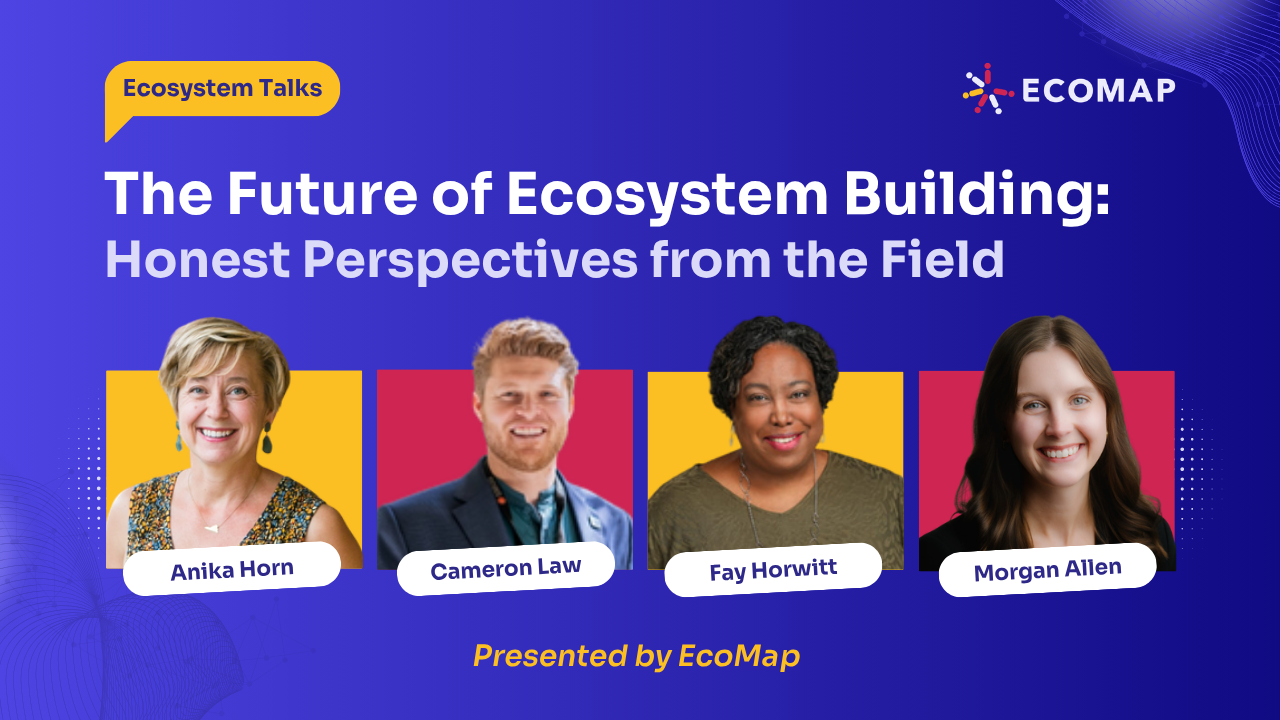
The field of entrepreneurial ecosystem building has grown faster in the last five years than at any point in its history. Whether it has grown better is a different question. In this Ecosystem Talks webinar, Anika Horn, author of the upcoming book It Takes A Valley, brought together three practitioners who have spent years inside the work for a conversation about what is changing on the ground.
Joining Horn were Morgan Allen of Right to Start, formerly with the Indiana Economic Development Corporation; Cameron Law, who leads the Carlson Center for Entrepreneurship at Sacramento State and serves as a Right to Start ambassador; and Fay Horwitt, leader of Waybuilders and the ESHIP Alliance.
How Are Ecosystem Builders Responding to Federal Funding Cuts?
The federal pullback has rippled across every level of the field. Law described what is happening regionally in Sacramento. The cuts were not specific to equity work. They hit ecosystem building broadly, including the coordination and infrastructure work that connects programs.
"That created more of a scarcity mindset," Law said. "It has people go to their corners and say, 'How do I get mine?' instead of doing the ecosystem work."
Sacramento felt the impact through the SBA's regional innovation clusters program. A regional organization leading an agrifood tech consortium lost the funding behind that work, with implications for how the region supports its food system. The 50 percent cut to the SBA also affected the SBIR and STTR pipelines that founders rely on.
What is keeping the work moving in Sacramento is a multi-year state investment in Accelerate California, which committed to building ecosystem infrastructure beyond a single grant cycle. Patient, multi-year commitment, Law noted, is what allows a region to absorb funding shocks.
Horwitt, who works at the national level, sees a parallel pullback in philanthropy. Corporate foundations and family foundations are pausing funding while they restructure their portfolios under government scrutiny. The instinct of many ecosystem organizations has been to pivot from government dollars to philanthropy, but Horwitt cautioned that the shift is not as straightforward as it sounds.
"This moment is exposing weaknesses that have existed for a long time," Horwitt said. "We've funded programs and entrepreneurs while underinvesting in the connective tissue, the relationships, the convening, the coordination. The question now is whether communities are willing to invest in that infrastructure."
Horwitt sees community foundations as the most natural future home for ecosystem building work, since they care about the long-term fabric of a community. The challenge is translating ecosystem work into metrics that match how community foundations measure success.
How Should Ecosystem Builders Talk to Policymakers in 2026?
Allen has spent her career inside government and now leads policy work at Right to Start. She watched the 2024 transition reshape how state EDCs talk about ecosystem work, and she expects 2026 to bring more of the same.
"There are a lot of governors coming up on the end of their term, and ecosystem building was the prior governor's thing in many states," Allen said. "Now it's become the political hot rock people don't want to grab."
Her advice for ecosystem builders working with elected officials starts with timing. Engage candidates now, before they take office, and engage candidates from across parties. The 2026 election cycle is unsettled enough that the safer move is to be in conversation with everyone.
The second piece of her advice is about translation. Ecosystem building is squishy as a category, and policymakers need it broken down. "You are investing in lowering poverty rates, increasing access to education, childcare, innovation," Allen said. "That is what makes it real for a policymaker."
Allen pointed to a Right to Start data point that has held up in policy conversations. A 1 percent investment in entrepreneurship correlates with a 2 percent reduction in poverty. Oversimplified on purpose, she said. Policymakers need a soundbite they can remember three weeks later.
The third piece is packaging stories with data. Allen described the importance of pairing a specific local business example with the broader outcome data. A small manufacturer in Crawfordsville, Indiana, becomes a way to make the case for entrepreneurship investment that a policymaker can repeat.
What Metrics Should Ecosystem Builders Claim?
Horwitt returned to a theme that came up several times in the conversation. Ecosystem builders have long claimed metrics they cannot defend, and the moment calls for more discipline.
"There is no causal chain that you can link back to say because you did entrepreneurial ecosystem building, this business grew by this percentage of revenue," Horwitt said. "We need to stop saying that."
Her framework breaks metrics into three time horizons. Short-term metrics include the things ecosystem builders can measure directly, like how many people showed up to a session, who signed up for a program, and who met whom in a partnership. Medium-term metrics include the outcomes those activities enable, like grants secured by entrepreneurs, partnerships formed between organizations, and growth in the capacity of support organizations themselves. Long-term metrics, the ones tied to revenue and job creation, belong to the support organizations and entrepreneurs themselves. Ecosystem builders should stop trying to claim them.
Horwitt has worked across more than 50 communities and learned that different funders prioritize different parts of that picture. Corporate funders, philanthropies, and government agencies all care about different things, and ecosystem builders need to be intentional about which data story they tell to whom.
"We have matured as a field, and now the metrics and measurement have to follow," Horwitt said. "If they do not, the funding will not follow."
What Made Sacramento a Case Worth Studying?
Law walked through how Sacramento became the first city in California to declare itself "Sacramento the Entrepreneurial." Getting the proclamation signed was only part of the win. What gave it weight was the specificity of the commitments inside it.
The proclamation required the city to designate a lead for entrepreneurship and to include entrepreneur voices in its forthcoming master plan for economic development. Law's team pushed for that specificity because they wanted the document to carry beyond a ceremonial signing.
Getting there required a sequence of meetings across many parts of city government, including city council members, their chiefs of staff, and the Office of Economic Development at both the staff and city manager level.
"It is a microcosm of the challenges an entrepreneur has in navigating a city," Law said. "You don't get there with one approach. You get there by working across many organizations."
Once the proclamation was in place, the Carlson Center partnered with EcoMap to visualize the region's ecosystem. The visualization gave funders and partners a way to see the people, programs, and connections supporting entrepreneurs in the region. For Law, that visibility has changed how he talks to funders.
"As a representation of the ecosystem building work at hand, this gave people something they could see," Law said. "When you can't see it, it is hard to sell it."
What Is Sustainable Ecosystem Building Asking of Practitioners?
The hardest part of the conversation came near the end. Horn asked the three practitioners how they sustain themselves through work that frequently asks more than it gives back.
Allen spoke first, and was direct about the cost of her last role. "I ran into someone recently who told me I looked like a cancer patient for a while," Allen said. The transition to Right to Start came after a period of severe burnout that she did not see coming. Her response has been to scale her ambition into more achievable pieces. "We can still do systems change. We can still work at a large scale. The question is how to make that change specific and achievable."
Horwitt described a shift she has been making at the field level. "For too long, we've had this hero builder model. The assumption that a few committed individuals could carry everything," Horwitt said. "We tell our communities to build resilient systems, but many of us have been operating in ways that are not personally sustainable."
The ESHIP Commons and the ESHIP Alliance are her attempt to build distributed leadership for the field. By creating a space where the work belongs to a larger group rather than a few individuals, Horwitt is trying to make the field itself more sustainable. "By gifting that to other ecosystem builders, I'm gifting it to myself."
Law was the most candid of the three. He does not have a system that has solved it yet. He has found running, and he returns often to a quote from Andy Stoll. "How do you lead when nobody is in charge?" Law said.
Horn closed by noting that of the nearly 200 ecosystem builders she has interviewed for her book and her podcast, more than half have either experienced or brushed against burnout. The pattern is too widespread to keep treating as an individual problem.
What Resources Should Ecosystem Builders Take Away?
A few practical resources came up across the hour. Horwitt recommended the ESHIP Commons as a free community for ecosystem builders. Allen pointed to Right to Start's America the Entrepreneurial campaign, which offers playbooks for civic engagement with policymakers, and the GoDaddy Small Business Research Lab for data. Law returned to Horwitt's E3 framework and its four pillars of people, programs, networks, and narratives as the clearest articulation of what ecosystem building involves.
Horn's book, It Takes A Valley, will be published in September 2026 and includes contributions from more than 50 ecosystem builders, including all three panelists. A community-supported edition is available now to pre-order.
Watch the full webinar on YouTube.
About the Speakers
Anika Horn is the host of the Ecosystems for Change podcast and the author of It Takes A Valley: How to Build Thriving Entrepreneurial Ecosystems That Transform Communities, publishing in September 2026. She has interviewed nearly 200 ecosystem builders and writes for ecosystem builders, economic developers, funders, and community leaders.
Morgan Allen, MBA, leads policy work at Right to Start, a national advocacy organization for entrepreneurship. She previously served at the Indiana Economic Development Corporation and brings a lean startup mindset to policy work.
Cameron R. Law leads the Carlson Center for Entrepreneurship at Sacramento State and serves as a Right to Start ambassador. He led the effort that made Sacramento the first city in California to declare itself "Sacramento the Entrepreneurial."
Fay Horwitt leads Waybuilders, an organization supporting cohorts of ecosystem builders, and serves in a national leadership role with the ESHIP Alliance, a network of entrepreneurial ecosystem builders. She previously led Forward Cities and developed the E3 framework that has shaped how many practitioners think about ecosystem building.
Frequently Asked Questions
How is federal funding for ecosystem building changing? Federal funding has pulled back from ecosystem building work in general, including programs that have nothing to do with equity. The SBA saw a 50 percent cut to programs like regional innovation clusters, and SBIR and STTR pipelines have faced delays. The pullback has created a scarcity mindset across regional ecosystems, with organizations competing for shrinking pools of capital instead of coordinating their work.
What metrics should ecosystem builders claim? Ecosystem builders should claim short-term metrics like attendance, engagement, and partnership formation, and medium-term outcomes like grants secured by founders and growth in support organization capacity. Long-term metrics tied to business revenue and job creation belong to the support organizations and entrepreneurs themselves. Horwitt argues that ecosystem builders weaken the field by overclaiming attribution they cannot defend.
How should ecosystem builders talk to policymakers? Engage early, talk to candidates of all parties, and translate ecosystem building into the language of community development. Allen recommends pairing a specific local business story with broader outcome data, and keeping the pitch short enough that a policymaker can repeat it weeks later. Right to Start's America the Entrepreneurial campaign offers playbooks for this work.
Why has burnout become a defining challenge in ecosystem building? The work is service-oriented, often underfunded, and structured around a small group of leaders carrying disproportionate responsibility. More than half of the ecosystem builders Horn has interviewed for her book and podcast have experienced or brushed against burnout. Horwitt argues that distributed leadership through networks like the ESHIP Commons is the only sustainable model.
What is the E3 framework? The E3 framework, developed by Horwitt, organizes ecosystem building work into four pillars. People, programs, networks, and narratives. Law identifies narratives as the area where most ecosystems score lowest, and stronger storytelling is what will make the case for continued investment in ecosystem work.